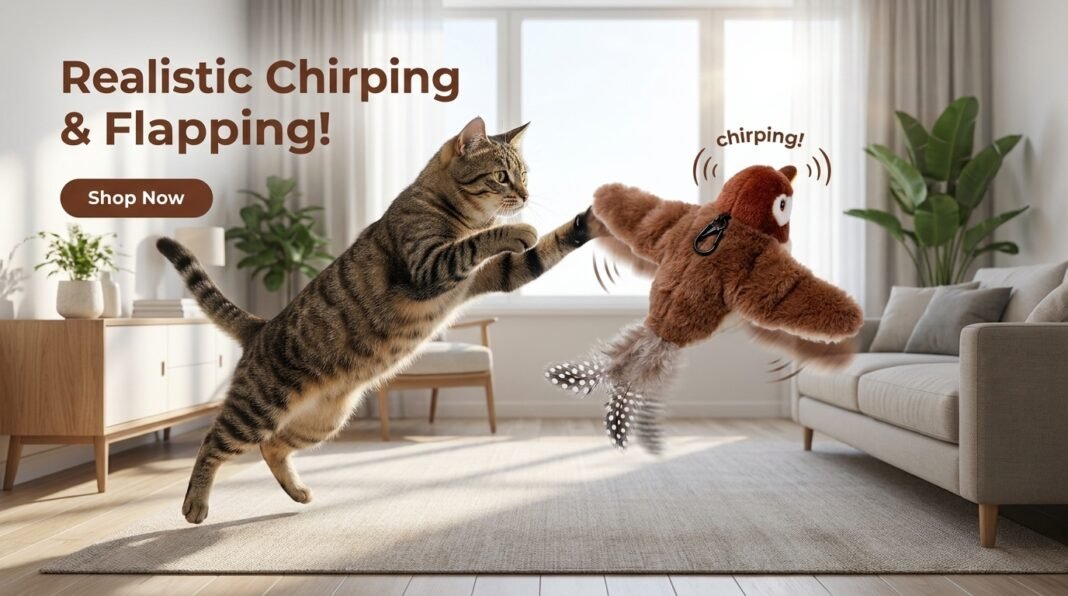
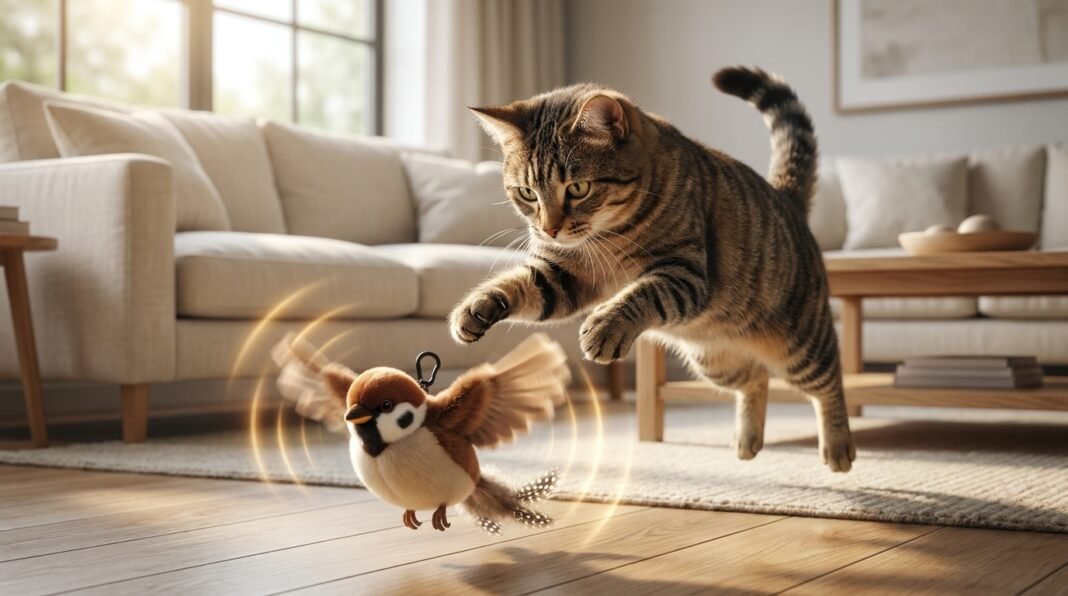

Most indoor cats aren’t “lazy” by nature—they’re under-challenged. The problem isn’t space alone, it’s the lack of unpredictable movement and prey-like stimulation.
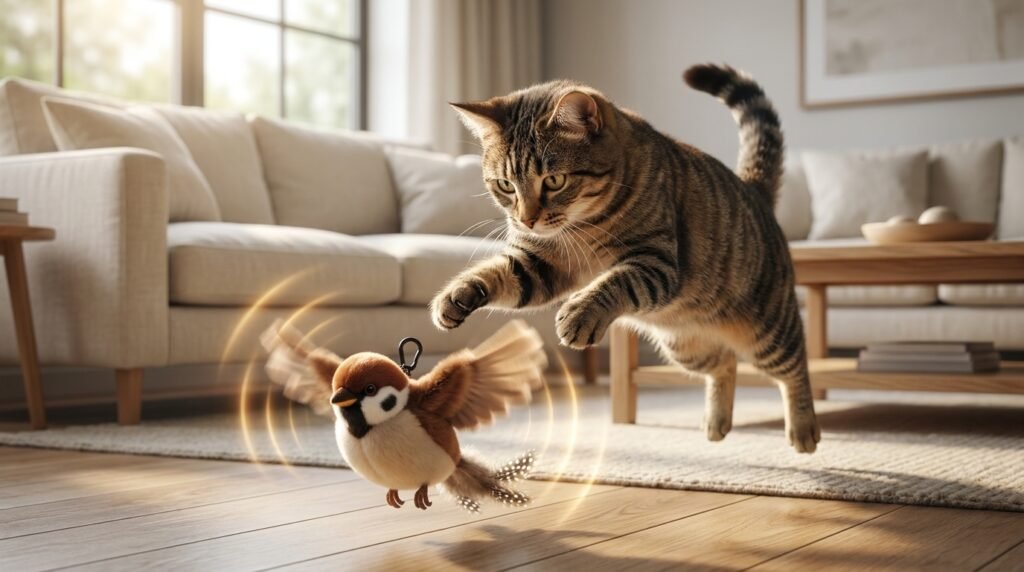
A toy like the Interactive Chirping Bird Cat Toy with Flapping Wings tries to replicate that missing layer: motion that reacts, sound that feels alive, and randomness that triggers instinct.
But let’s be honest—many “interactive toys” fail because they’re either too predictable or too fragile. If a cat figures out the pattern in under two minutes, engagement drops fast.
This is where simulation-based toys aim to fix that gap.
What This Toy Actually Does (Beyond Marketing Claims)
This product category usually combines three elements:
- Bird-like chirping sounds
- Mechanical wing flapping
- Movement or shaking simulation (electric motor-based)
The idea is simple: trigger prey-response behavior in cats.
Core Function Breakdown
Instead of relying on human-driven play, the toy attempts to simulate:
- Sudden movement (like a startled bird)
- Audio cues (chirping for attention)
- Visual unpredictability (wing motion)
The goal isn’t realism in a strict sense—it’s perceived prey behavior.
Why Cats React to It So Strongly
Cats don’t “play” for entertainment. They play to rehearse hunting behavior.
This toy hits three instinct triggers:
1. Motion Detection Instinct
Cats are wired to detect small, irregular movements. A flapping motion that isn’t perfectly rhythmic is more effective than a smooth one.
2. Sound Localization
Bird chirping works because it mimics high-frequency prey signals. It forces attention even before visual contact.
3. Chase Completion Loop
Cats need closure in play: stalk → chase → pounce. If any step is missing, interest fades.
Most basic toys only cover one of these stages. This type tries to combine all three.
Where This Type of Toy Fails (Important Reality Check)
Not every cat responds the same way, and expectations matter.
Weak points you should consider:
- Overstimulation risk: Some cats get confused or scared instead of engaged
- Mechanical fatigue: Motors and flapping mechanisms wear out faster with aggressive play
- Pattern recognition: Once movement becomes repetitive, interest can drop
- Noise sensitivity: Constant chirping may annoy both cats and owners over time
If someone expects this toy to replace human interaction completely, that’s unrealistic.
When It Works Best
This toy performs better under specific conditions:
- Indoor-only cats with limited stimulation
- Younger cats with higher energy levels
- Single-cat homes (less social play competition)
- Short, controlled play sessions instead of continuous use
It’s not a “set and forget forever enrichment tool.” It works more like a trigger-based activity device.
Exercise Benefits: Real, but Limited
Yes, it can increase movement. Cats may:
- Sprint toward motion
- Jump and pounce
- Engage in short bursts of chasing
But here’s the limitation most people ignore:
This is burst exercise, not sustained activity. That means it helps energy release, but it won’t replace climbing structures, vertical spaces, or human play sessions.
Best results come when it’s part of a mixed enrichment setup.
Mental Stimulation Factor
Where this toy is stronger is cognitive engagement.
Cats are forced to:
- Track unpredictable motion
- Reassess target position repeatedly
- Adjust hunting strategy mid-play
This mimics real hunting better than static toys, which is why some cats stay engaged longer.
But again, novelty decay is real. Rotation is necessary.
Practical Use Strategy (If You Actually Want Results)
Most owners misuse interactive toys by leaving them on all day. That reduces impact.
Better approach:
- Use for 10–15 minute sessions
- Activate during peak activity times (morning/evening)
- Store it out of sight between sessions
- Rotate with other toys weekly
This keeps the “prey illusion” intact instead of turning it into background noise.
Who Should Avoid This Type of Toy
This isn’t universal.
You might skip it if:
- Your cat is already easily overstimulated
- You prefer silent environments (chirping may be disruptive)
- You expect long-duration independent play without maintenance
- Your cat ignores motion-based toys entirely
Not every cat responds to artificial prey simulation—and forcing it doesn’t change behavior patterns.
Final Assessment
The Interactive Chirping Bird Cat Toy with Flapping Wings sits in a specific category: stimulation-focused enrichment tools designed to mimic hunting cues, not replace real interaction.
It works best when:
- Used in controlled sessions
- Paired with other enrichment tools
- Matched with a cat that responds to motion and sound triggers
It fails when treated as a permanent entertainment device.
In short: it’s a behavioral trigger, not a solution to boredom by itself.